← Work
Live product · 2026 Pixelhatch technical showcase

A playful product with a serious operational core.

Zombify turns AI model lifecycle risk into something developers can actually see, check and understand. The public experience is deliberately simple; behind it sits a human-reviewed registry, ingestion system and operational control layer built to keep the signal trustworthy.

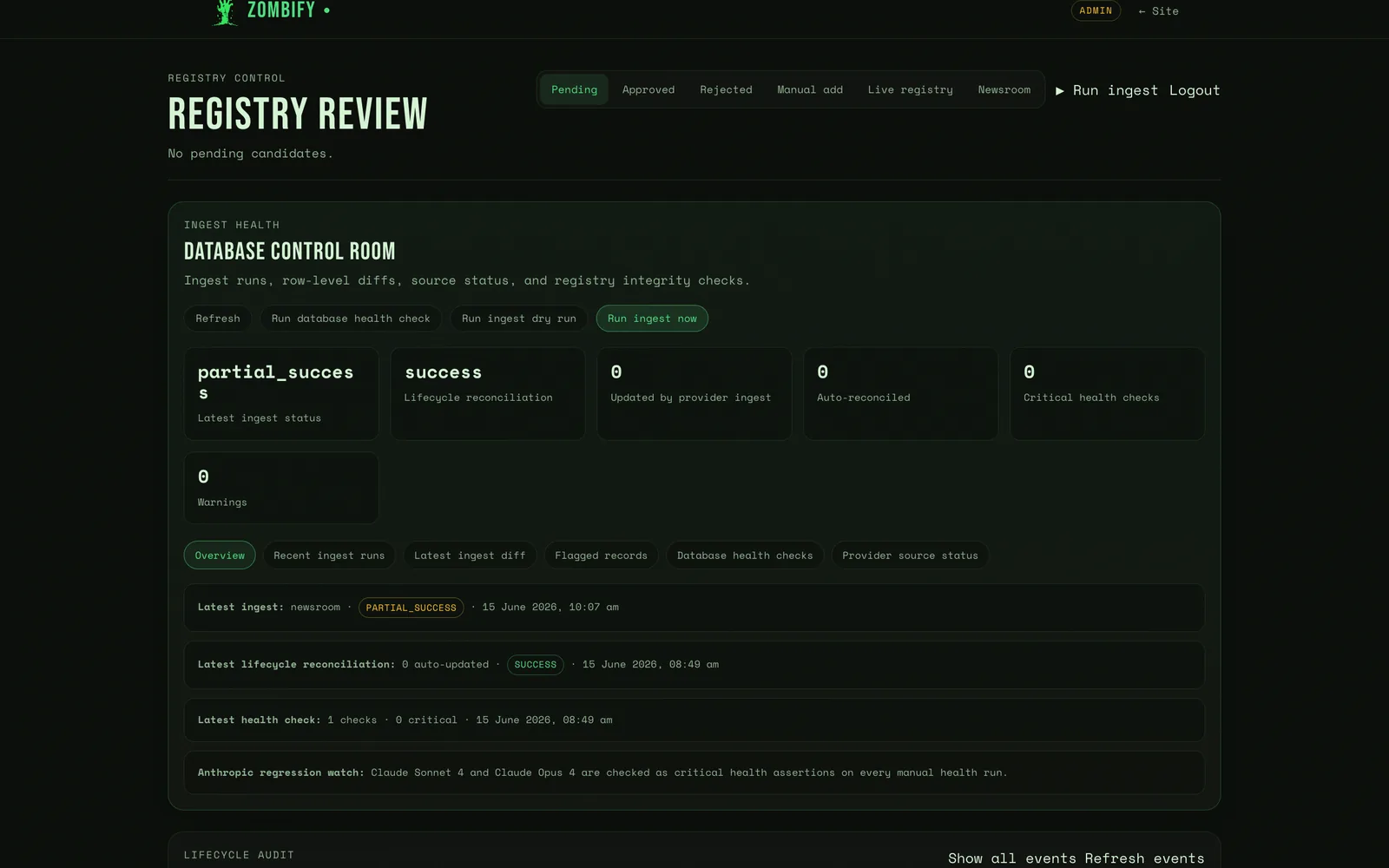
Zombify Registry Review admin showing ingest health, database control and lifecycle events

Why it stays live

A live product can be useful in more than one way.

Zombify solves a real problem: model IDs are production dependencies, and providers can deprecate, rename, restrict or retire them underneath an application.

The public product gives that risk a clear, memorable interface. The deeper value is the system behind it: structured lifecycle data, observable ingestion, source confidence, human review and an admin layer that makes uncertain signals manageable.

That makes Zombify useful twice: as a live product people can use, and as working proof of how Pixelhatch connects product thinking, AI-assisted data operations and human control.


What was actually built

The public checker is only the front door.

The strongest proof in Zombify is the operational layer behind the joke: a lifecycle registry with ingestion, auditability and human control.

01

Free Model Checker

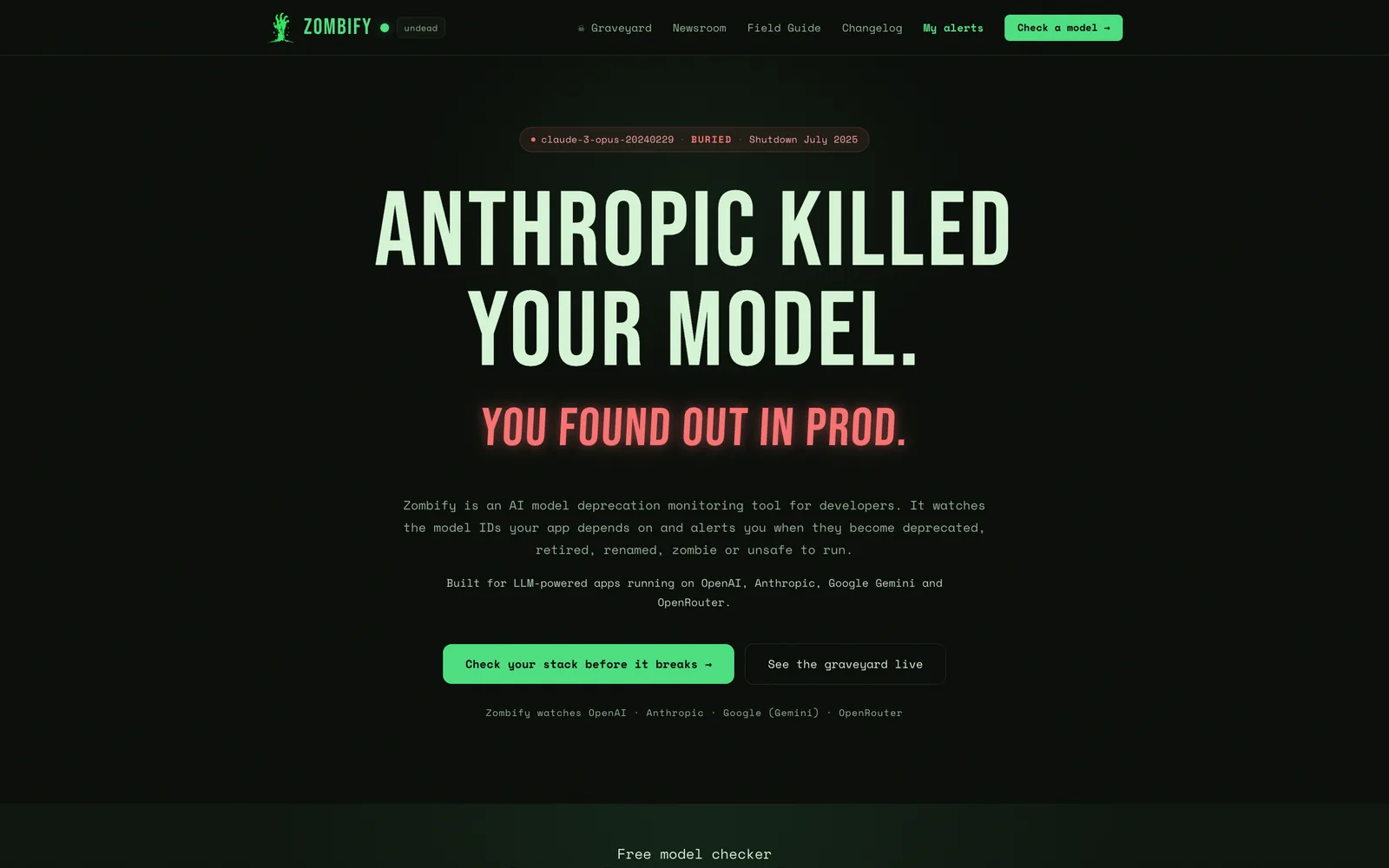
The public hook is immediate utility: choose a provider and model ID, or surface IDs from a pasted .env file, then check whether the dependency is active, at risk, deprecated, zombie or retired.

components/ModelChecker.astro · api/check-model.ts
02

Watchlist + status surface

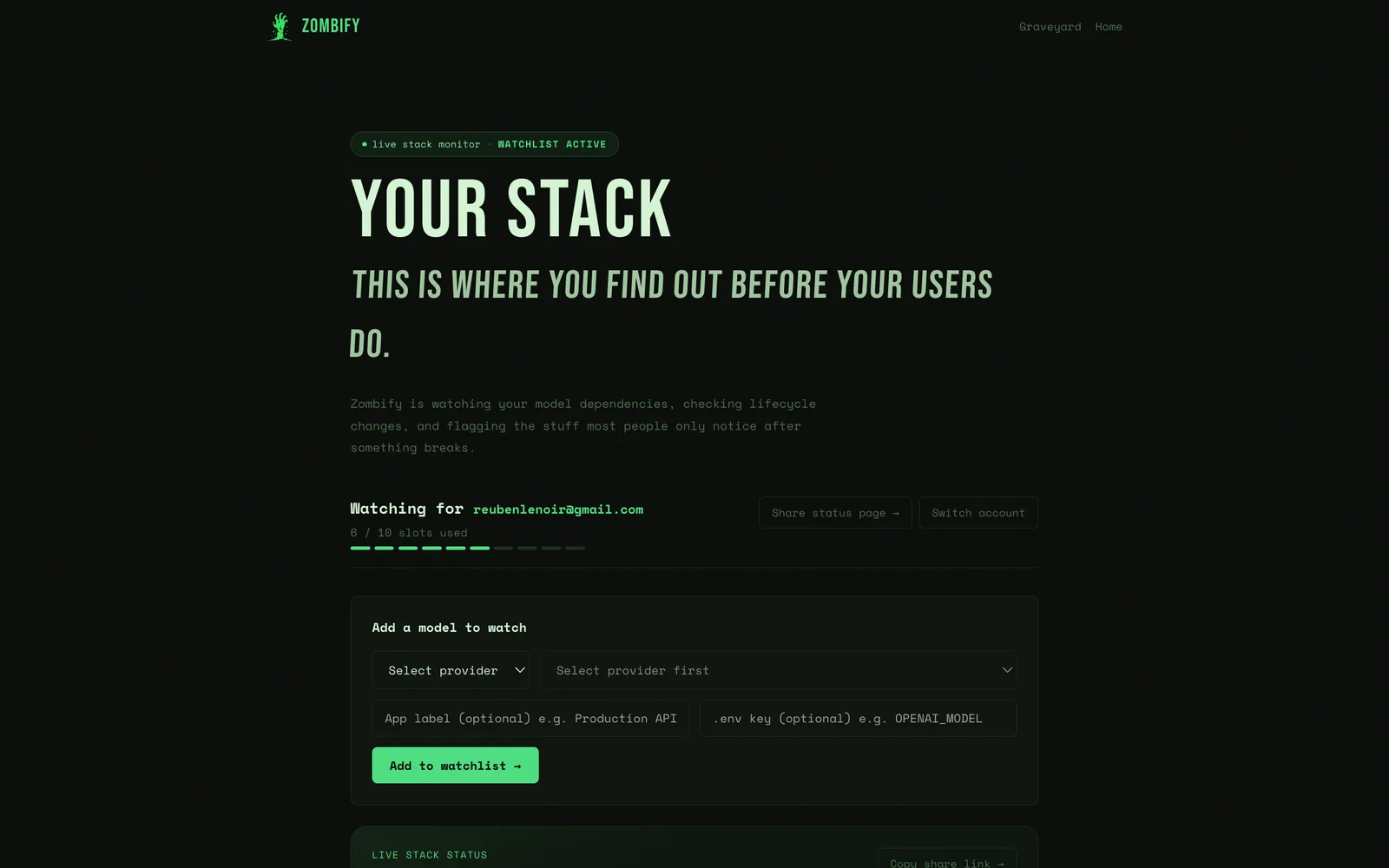
The product grew beyond a one-off checker into a monitored model stack with magic-link access, lifecycle alerts and shareable status views — turning lifecycle data into something teams can actually use.

pages/dashboard.astro · pages/status/[token].astro
03

Registry Review

The interesting part sits behind the public interface: pending, approved and rejected candidates; manual overrides; live-registry editing; lifecycle events; source confidence and explicit human review before uncertain signals become public truth.

pages/admin/registry-review.astro · migrations/003–006
04

Ingest + newsroom control

Provider ingestion is observable rather than magical. Runs, row-level diffs, source status and health checks sit beside a newsroom workflow with draft, review, published and archived states, source classification and copyright-safe publishing guardrails.

api/admin-ingest-* · lib/newsroomIngest.ts · migrations/007–016

Product proof

Public utility. Private control room.

Zombify public landing page and model checker
Public experience — model checking, lifecycle framing and utility-led discovery.
Zombify monitored model stack dashboard
Watchlist surface — monitored dependencies and shareable status.
Zombify Registry Review and database control room
Admin system — registry review, ingest health, lifecycle audit and human override.

Architecture

A small product with a surprisingly serious backend.

The system combines a public developer utility with server routes, a structured lifecycle database, authentication, ingestion observability and an editorial review layer.

Astro + Cloudflare adapterCloudflare Worker runtimeSupabase Postgres + AuthHuman-reviewed lifecycle registryIngest runs + row-level change ledgerSource confidence + newsroom publishing
Why the live product matters
A working product is stronger proof than a mockup.
Use

The checker, Graveyard and Newsroom as a clear public product for understanding model lifecycle risk.

Trust

Back public status with source confidence, lifecycle events, ingest health and explicit human review.

Show

The Registry Review control room as proof that a simple front end can sit on top of a serious operational system.

Prove

Zombify demonstrates how Pixelhatch can connect brand, product UX, data systems, AI-assisted ingestion and human operations.